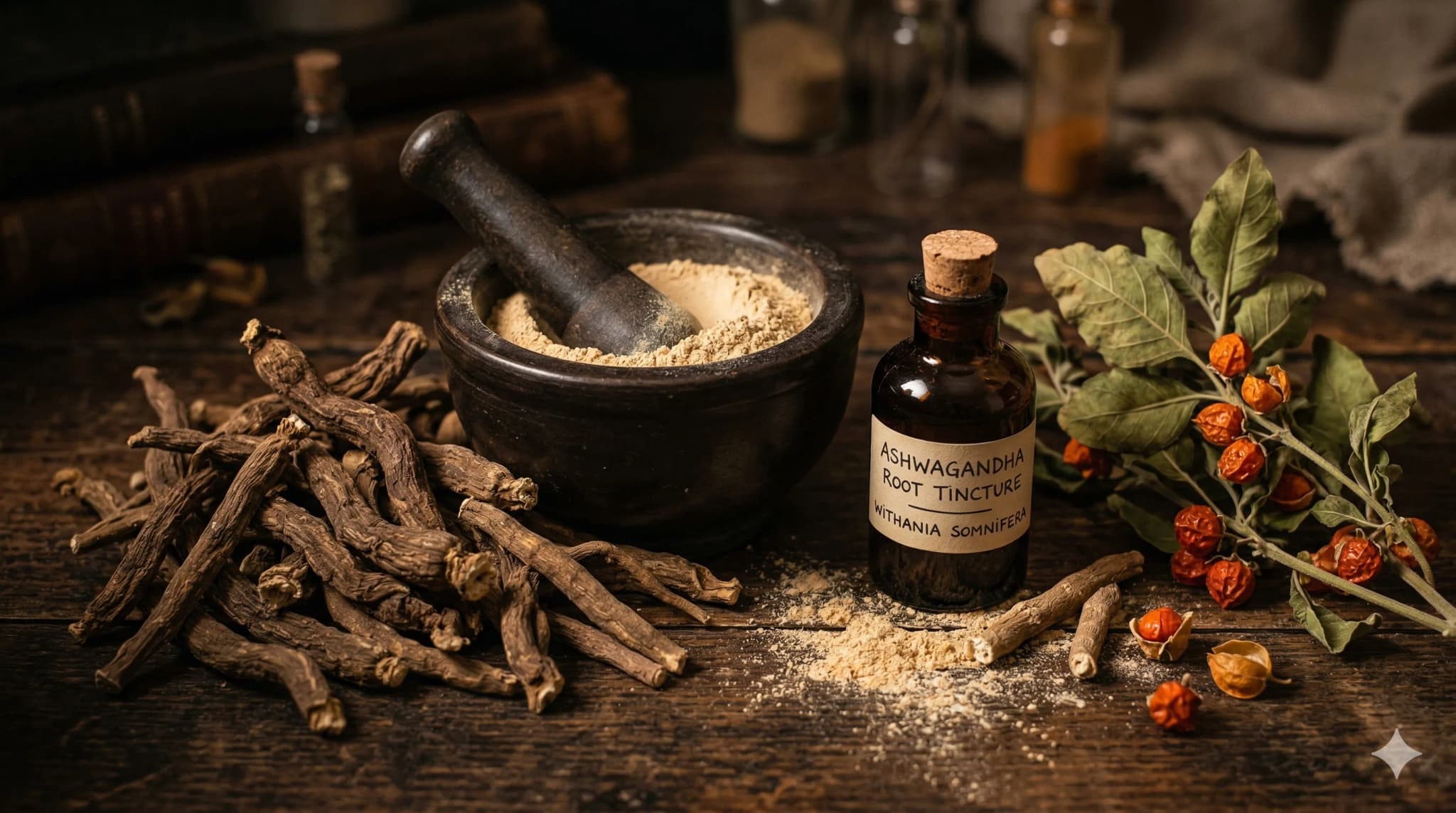
Ashwagandha (Withania somnifera) is one of the most important herbs in Ayurvedic medicine — and one of the most misunderstood in the modern wellness space. It’s marketed as a stress-buster, a sleep aid, a testosterone booster, a cognitive enhancer. Some of these claims are supported by research. Some are not. All of them miss the deeper point.
In Ayurveda, ashwagandha is classified as a rasayana — a rejuvenative tonic. Rasayanas are not quick fixes. They are herbs you take consistently, over time, to rebuild the body’s deep reserves. The Sanskrit name itself — ashwagandha, “smell of the horse” — refers not to its (admittedly earthy) aroma but to the vitality and strength it’s said to confer.
The root is the part used medicinally. It contains a class of compounds called withanolides — steroidal lactones that modulate the hypothalamic-pituitary-adrenal (HPA) axis, the body’s central stress-response system. This is what makes ashwagandha an adaptogen: it doesn’t stimulate or sedate. It helps the body calibrate its own response to stress.
Clinical evidence supports its use for cortisol modulation, anxiety reduction, sleep quality improvement, and exercise performance. The strongest evidence is for chronic stress and anxiety — multiple randomized controlled trials show statistically significant reductions in perceived stress and cortisol levels with consistent use over 8–12 weeks.
A note on why you won’t find it in our formulas. Everything above is still true of the herb. We don’t build with ashwagandha ourselves — as global demand drove rapid monoculture expansion, with the heavy chemical inputs and soil depletion that follow, the sourcing picture stopped meeting the standard we hold every adaptogen to. Where a formula of ours calls for calm and restoration, we reach for reishi; where it calls for easing stress, holy basil.