From the Apothecary
Every adaptogen in our formulas earns its place twice: once for what it does in the body, and once for its carbon footprint and sustainability — the impact of the place it grew. When those two answers don’t agree, we leave it out — even when it’s popular, even when it sells.
Here’s the full accounting: twelve adaptogens we build with, eight we won’t touch, and the reasoning behind every line.
Popularity and sustainability aren’t the same question.
An adaptogen can be effective and still be a poor choice — if the only way to get it is to strip a slow-growing wild population, or if the way it’s farmed degrades the soil it depends on. We ask both questions before anything reaches a bottle: does it work, and can it keep working at the scale we’re asking of it?
That standard rules a few well-known names out entirely. It also means the adaptogens we do use sometimes come with real caveats — sourcing rules we hold ourselves to, not just ingredients we buy off a list.
| 12 | Adaptogens we formulate with — each cultivated, farmed, or grown in ways that don’t draw down a wild population. |
| 8 | Adaptogens we deliberately don’t use — despite real popularity, over a mix of ecological and safety concerns. |
What we use
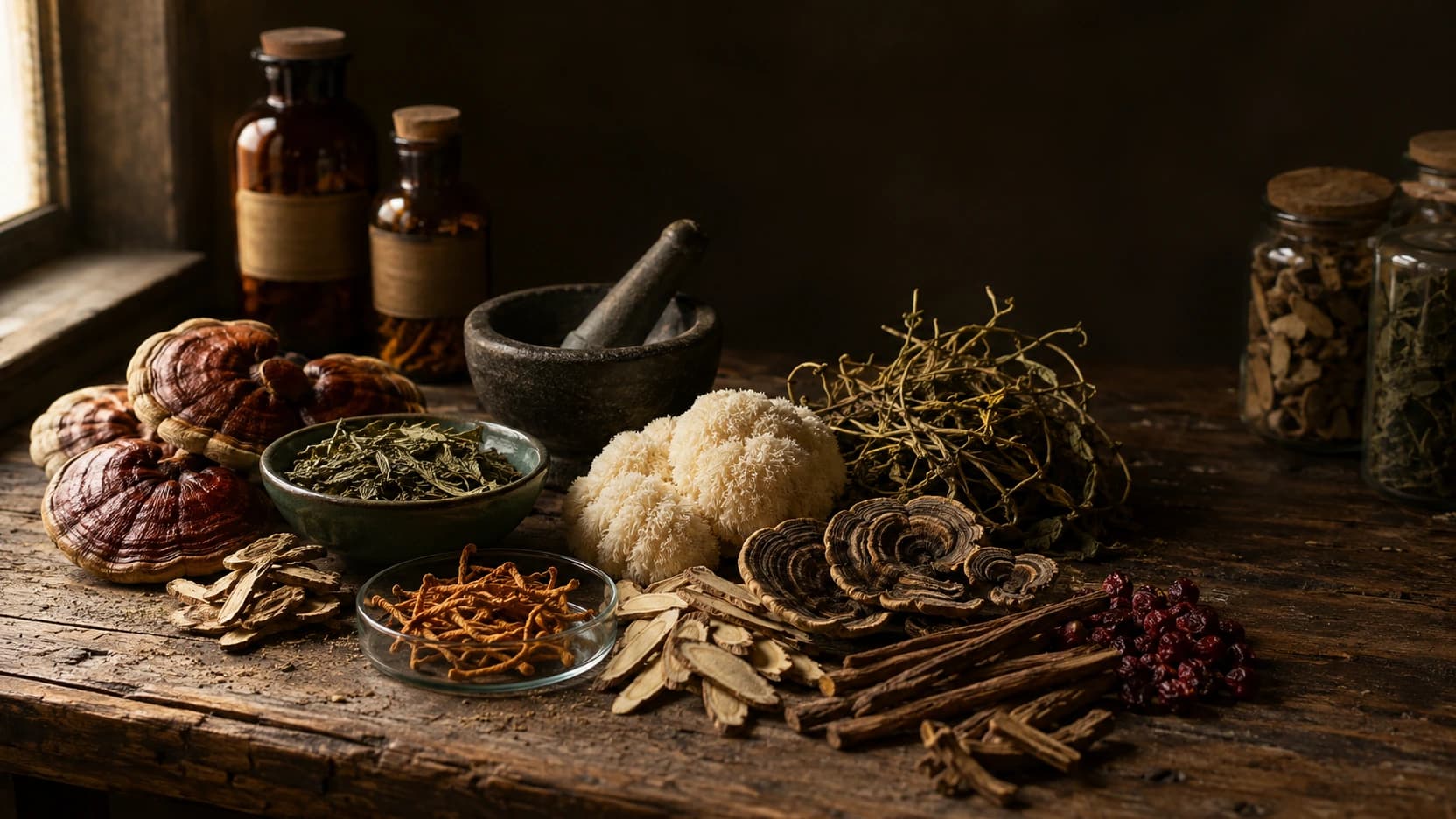
Twelve adaptogens, each earning its place
Ranked by how directly each one can be grown or farmed without pressuring a wild population. Even our most-used herbs vary here — which is exactly why we check, ingredient by ingredient, rather than trusting a category.
| Adaptogen | Sustainability standing |
|---|---|
| Reishi | Exceptional |
| Holy Basil / Tulsi | Exceptional |
| Lion’s Mane | Exceptional |
| Jiaogulan | Exceptional |
| Cordyceps (militaris) | Exceptional |
| Turkey Tail | High |
| Astragalus | High |
| Dang Shen | High |
| Eleuthero | High |
| Schisandra | Good, tested |
| Licorice | Good, tested |
| Maca | Sourced with care |
Schisandra Schisandra chinensis
Why we use it — Traditionally used to support liver function and steady mental focus. The classic “five-flavor” berry — sweet, sour, salty, bitter, and pungent all at once.
Sustainability — Harvested from mature berries without disturbing the vine. A stable crop — we test every batch for pesticide and heavy-metal accumulation in concentrated extracts.
Eleuthero Eleutherococcus senticosus
Why we use it — Traditionally used to support physical endurance and immune resilience. Warm, woody, mildly bitter.
Sustainability — A fast-growing woodland shrub — roots are harvested from plants at least 3–4 years old, with far less ecological pressure than true ginseng.
Holy Basil / Tulsi Ocimum sanctum
Why we use it — Traditionally used to ease stress and support a calm nervous system. Bright, peppery, aromatic.
Sustainability — One of the most eco-friendly plants we work with — thrives in smallholder polyculture and regenerative gardens with minimal water or land.
Reishi Ganoderma lucidum
Why we use it — Traditionally used to calm the nervous system and support deep, restful sleep. Deeply bitter, woody, earthy.
Sustainability — Grown almost entirely indoors on wood-log or sawdust-bag waste — about as close to zero wild disruption as an adaptogen gets.
Licorice Glycyrrhiza glabra
Why we use it — Supports adrenal function, soothes irritated tissue, and rounds out the flavor of nearly every blend it’s in.
Sustainability — A nitrogen-fixing legume that enriches the soil it grows in. We source from growers who replant root-crown cuttings immediately after harvest to prevent erosion.
Astragalus Astragalus membranaceus
Why we use it — A foundational Qi tonic across our Seasonal line — traditionally used to support immune defenses and long-term vitality.
Sustainability — Farmed extensively at commercial scale, which keeps damaging pressure off wild populations entirely.
Jiaogulan Gynostemma pentaphyllum
Why we use it — Known as “Southern Ginseng” — traditionally used to support healthy blood pressure, cholesterol, and cellular energy.
Sustainability — A highly resilient, fast-spreading ground vine. Regenerates rapidly after trimming and needs very little agricultural intervention.
Dang Shen / Codonopsis Codonopsis pilosula
Why we use it — A gentler stand-in for Panax ginseng — traditionally used to strengthen digestion and lung capacity.
Sustainability — Grown quickly on farms rather than dug from slow-growing forest stands, sparing the wild species it substitutes for.
Lion’s Mane Hericium erinaceus
Why we use it — Traditionally used to support memory and mental clarity. Mildly sweet, savory, almost seafood-like.
Sustainability — Cultivated cleanly indoors on sawdust blocks or agricultural waste — negligible land or water footprint.
Turkey Tail Trametes versicolor
Why we use it — Traditionally used to support immune resilience and gut microbiome health. Earthy, bitter, distinctly mushroomy.
Sustainability — One of the most common wood-decay fungi in the world — grows effortlessly on low-cost indoor log substrate.
Cordyceps C. militaris (cultivated)
Why we use it — Traditionally used to support stamina, athletic endurance, and lung capacity.
Sustainability — We use only the cultivated militaris species, grown indoors on vegan grain substrate — never the wild, caterpillar-borne C. sinensis harvested from the Tibetan Plateau. Same active compounds, none of the high-altitude ecological toll.
Maca Lepidium meyenii
Why we use it — Traditionally used to support energy and hormonal balance without the jitters some stimulants bring. Earthy, malty, faintly caramel.
Our One Exception. Everywhere else on this page, a real sourcing risk means we leave the herb out. Maca is the one case where we solved the sourcing problem instead of walking away. Standard commercial maca is grown as a monoculture row crop, which tills and degrades high-Andean soil over successive seasons — so we buy exclusively from cooperative, native-led Andean farms still practicing the traditional crop rotation that’s kept those soils productive for centuries. Same land, same growers, none of the industrial shortcut. And it stays on this list because nothing else in our materia medica replaces it. Nothing here pairs energy support with hormonal balance through a non-estrogenic, non-stimulating mechanism the way Maca does — that specific combination is why we looked for a better source instead of a substitute.
What we don’t use
Eight adaptogens we leave out, on purpose
Every one of these has real, documented benefits — that’s exactly why they’re everywhere. But each carries a risk that’s either medical, ecological, or both, and in every case, we’d rather explain the gap than paper over it.
| Why we say no | Herbs |
|---|---|
| Wild-harvest pressure | 3 |
| Bioaccumulation risk | 2 |
| Can’t be farmed sustainably | 1 |
| Non-renewable resource | 1 |
| Industrial quality decline | 1 |
Rhodiola Rhodiola rosea
Sustainability — A slow-growing arctic/alpine plant. Wild populations in Siberia and Scandinavia are critically over-harvested, damaging tundra ecosystems that take decades to recover.
Traditionally valued for — supporting energy, mental stamina, and resilience under stress and fatigue.
The concern — can cause insomnia, irritability, and overstimulation, particularly for anyone prone to anxiety.
Use instead — Eleuthero covers much of the same ground — stress resilience and steady endurance — without the wild-harvest pressure.
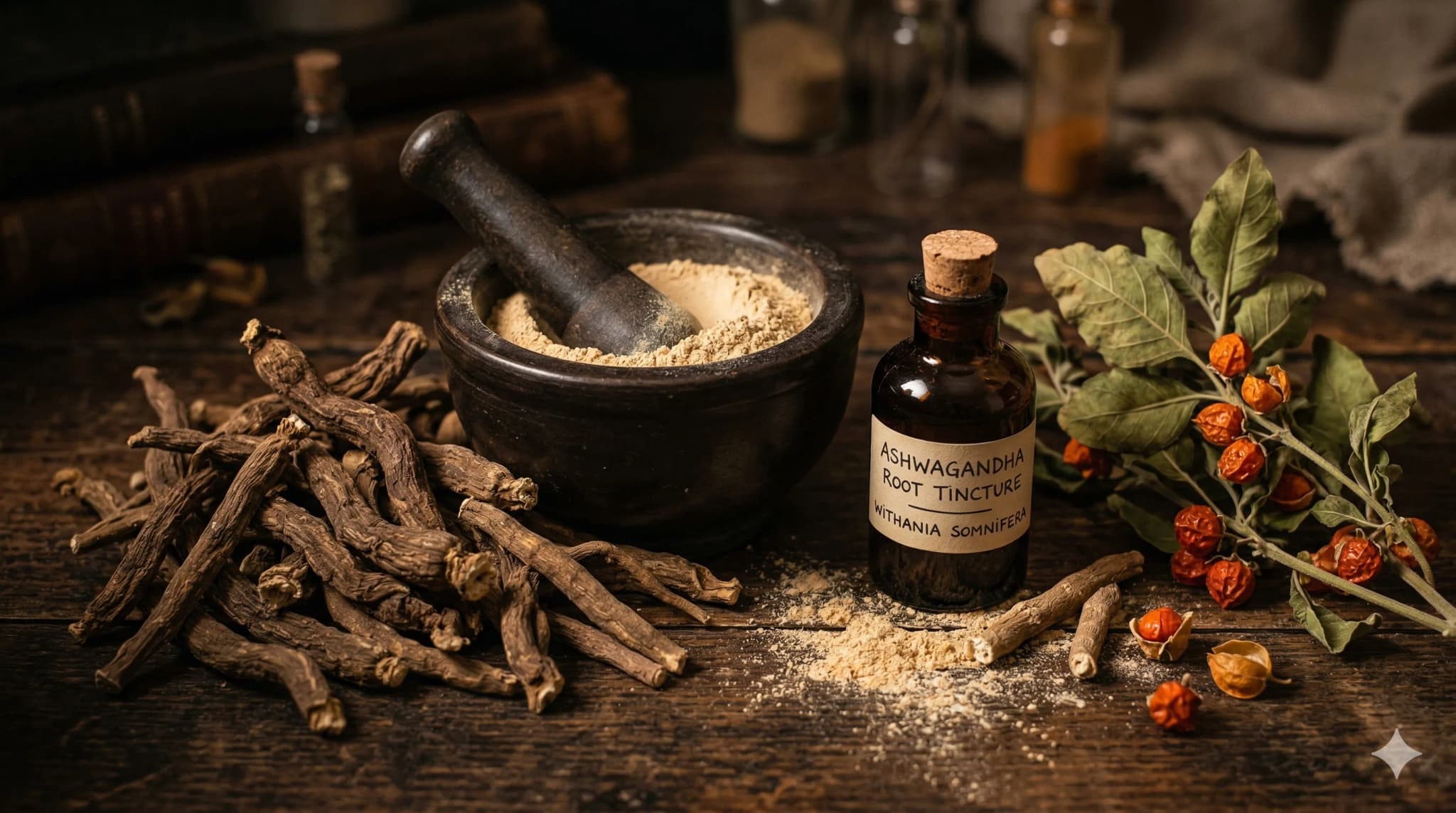
Ashwagandha Withania somnifera
Sustainability — Explosive global demand has driven rapid monoculture expansion — heavy chemical inputs and soil depletion follow.
Traditionally valued for — easing stress, supporting restful sleep, and building overall vitality.
The concern — can affect thyroid function and, in rare cases, has been linked to liver strain or GI upset.
Use instead — Reishi covers the calming, restorative side; Holy Basil covers the stress-easing side. Between the two, most of what people reach for Ashwagandha for is already here.
Panax Ginseng Panax ginseng
Sustainability — True wild ginseng is nearly extinct after centuries of poaching; it takes 6–10 years to mature, which keeps driving illegal forest harvesting.
Traditionally valued for — sharpening cognitive and physical performance, the classic Qi tonic.
The concern — frequently overstimulating (insomnia, elevated blood pressure, palpitations) and interacts with blood thinners and diabetes medication.
Use instead — Dang Shen / Codonopsis — a gentler, farm-grown ginseng substitute already in our lineup.
Chaga Inonotus obliquus
Sustainability — Can’t be effectively farmed in its true medicinal form. Demand drives over-foraging that wounds host birch trees and disrupts forest ecology.
Traditionally valued for — its antioxidant content, supporting immune health and general vitality.
The concern — very high in oxalates, a real concern for kidney stones with regular use.
Use instead — Reishi or Turkey Tail — both sustainably farmed fungi already in our lineup, covering similar immune-support ground.
Shilajit mineral pitch
Sustainability — A finite mineral resin formed over centuries in Himalayan rock — not a renewable crop. Scraping operations damage fragile alpine zones.
Traditionally valued for — its mineral density, used as a general rejuvenation tonic for energy and stamina.
The concern — real risk of heavy metal, arsenic, or mycotoxin contamination if not properly purified.
Use instead — No single herb replaces it exactly, but Astragalus covers the long-term-vitality role without the contamination risk or the non-renewable sourcing.
Gotu Kola Centella asiatica
Sustainability — Grows in wetlands, where it acts as a natural bio-accumulator — soaking up agricultural runoff and heavy metals from the water it’s harvested from.
Traditionally valued for — supporting memory, mental clarity, and healthy circulation.
The concern — high doses can strain the liver and cause headaches or skin rashes.
Use instead — Lion’s Mane covers the memory-and-clarity ground, grown indoors on clean substrate rather than pulled from polluted wetlands.
Brahmi Bacopa monnieri
Sustainability — An aquatic plant that readily absorbs lead, cadmium, and other pollutants from the waterways it’s wild-foraged from.
Traditionally valued for — memory and focus, a classic Ayurvedic brain tonic.
The concern — can cause GI upset and, in some cases, an excessively slowed heart rate.
Use instead — Same answer as Gotu Kola: Lion’s Mane, grown clean, covers the cognitive-support role.
Shatavari Asparagus racemosus
Sustainability — Massive demand for women’s health products has driven destructive wild-root digging across India, threatening local biodiversity.
Traditionally valued for — supporting women’s hormonal and reproductive health.
The concern — strongly estrogenic, not appropriate for anyone with a hormone-sensitive condition.
Use instead — Maca supports hormonal balance through a different, non-estrogenic mechanism — close enough in purpose that we don’t need both.
The Short Version
We’d rather explain a gap in the lineup than quietly source around it. If an adaptogen can’t be grown, farmed, or harvested in a way that holds up ten years from now, it doesn’t matter how well it works today — it doesn’t belong in something we’re asking you to take every day. That’s the whole standard, applied the same way to all twenty herbs on this page.